

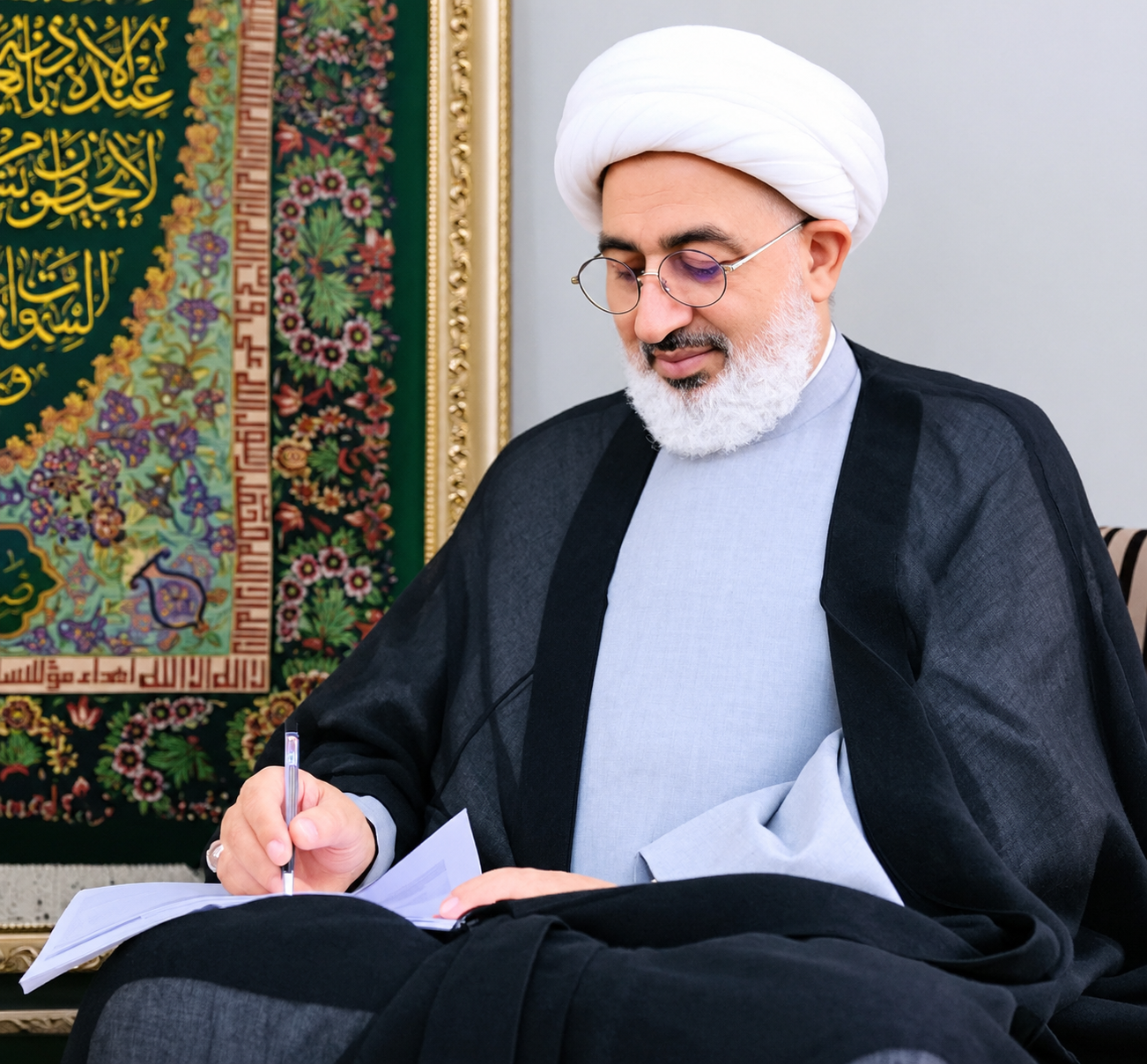
By Ayatollah Dr. Abdul Majid Hakim Elahi
Conceptual and analytical article
Abstract
The expansion of digital media, global communication, and artificial intelligence is changing how religious knowledge is accessed, interpreted, and shared among younger generations. Traditional channels of religious learning—including family, mosques, seminaries, and sermons—now operate alongside search engines, social media platforms, video-sharing services, and AI systems that also circulate religious information. This article examines what these changes mean for the scholarly and educational responsibilities of religious authorities, with particular attention to the diverse social and religious context of India.
Using a conceptual and analytical approach informed by digital religion studies, the sociology of religion, and religious epistemology, the article considers the relationship between inherited religious identity and informed understanding, the changing conditions of epistemic authority in digital environments, and the implications for religious outreach. It argues that abundant access to information increases the importance of source evaluation, transparent reasoning, media literacy, and scholarly accountability. However, digital access alone does not prove that religious commitment is declining or that scholars have lost their authority. The article proposes an outreach framework built around connecting religious practices with deeper learning, critically verifying religious materials, strengthening intergenerational dialogue, developing multilingual content, and using artificial intelligence responsibly. It also recommends independent empirical research on the information sources, questions, and learning needs of Shi‘i youth in India.
Keywords: epistemic authority; Shi‘i youth; digital religion; religious identity; religious outreach; Shi‘i communities in India; artificial intelligence; media literacy
1. Introduction
Recent developments in communication technology have changed not only the tools through which information travels but also the social conditions in which knowledge is produced, distributed, and evaluated. Religious questions that were once commonly discussed through family members, teachers, religious scholars, and local institutions can now be taken to search engines, social networks, video platforms, and AI-powered systems.
This situation raises an important question for religious institutions: when young people encounter multiple—and sometimes conflicting—sources of information, how do they decide which sources deserve trust, and what role should religious scholars play in helping them assess religious claims?
The question is especially significant for Shi‘i communities because their intellectual and spiritual heritage includes extensive traditions of hadith, theology, jurisprudence, legal theory, philosophy, Qur’anic interpretation, and ethics. Transmitting this heritage involves more than preserving rituals or repeating familiar teachings. It also requires helping learners understand the grounds of religious beliefs, distinguish reliable sources from unreliable ones, and respond thoughtfully to contemporary questions.
In India, these issues arise within a socially, linguistically, and religiously diverse setting. Shi‘i identity may be shaped by family traditions, community life, local cultures, national contexts, and interaction with other religious communities. Accordingly, this article considers both the wider transformation of epistemic authority in digital environments and the specific challenges of deepening Shi‘i religious learning in India.
The central research question is: What scholarly, educational, and communicative responsibilities does the transformation of epistemic authority in the digital age create for Shi‘i religious scholars seeking to transmit the teachings of the Ahl al-Bayt to younger generations in India?
The article addresses four related questions: (1) How are inherited religious identity and informed religious understanding related? (2) How does the expansion of digital information affect access to religious knowledge and the evaluation of its credibility? (3) How can religious authenticity be protected while misinformation and distortion are addressed and new technologies are used responsibly? (4) What framework can guide future outreach and research concerning Shi‘i communities in India?
2. Previous Research and the Article’s Contribution
2.1. Digital religion studies
Digital religion scholarship examines how religious beliefs, practices, communities, and authority interact with digital media. Campbell’s edited volume Digital Religion: Understanding Religious Practice in New Media Worlds explores the varied ways religious traditions engage with new media environments (Campbell, 2013). This perspective suggests that technology should not be treated merely as a neutral channel for distributing messages. Media platforms can influence how people encounter information, participate in communities, and experience religious life.
Campbell and Garner’s Networked Theology: Negotiating Faith in Digital Culture further examines the relationship between faith and digital culture (Campbell & Garner, 2016). These works provide useful conceptual resources, but their frameworks should not be transferred directly to Shi‘i communities in India without contextual analysis and empirical testing.
2.2. Religion and identity in India
Pew Research Center’s Religion in India: Tolerance and Segregation draws on 29,999 face-to-face interviews with Indian adults conducted in 2019 and 2020. It examines religious identity, attitudes toward religious diversity, and selected beliefs and practices across religious groups (Pew Research Center, 2021). The report is important for understanding the broader social context of religion in India, but it does not provide a complete, standalone account of the epistemic habits or religious learning needs of Shi‘i youth.
2.3. Research gap and contribution
The literature points to two connected areas of inquiry: the relationship between religion and digital environments, and the social and religious particularities of India. This article brings these areas together by focusing on epistemic authority, informed religious identity, and the renewal of religious outreach. Its contribution is conceptual: it offers an analytical framework for discussing the responsibilities of religious scholars. It does not claim to measure the views of all Shi‘i youth or to establish a causal relationship between digital-media use and changes in religious commitment. Such claims require dedicated empirical research.
3. Method and Conceptual Framework
This is a conceptual and analytical article. It examines selected literature on digital religion, considers the relationship between identity and epistemic authority, and draws out educational and communicative implications for Shi‘i communities in India. Public data on India’s digital environment and broader religious attitudes are used only to establish context, not as direct evidence about Shi‘i youth.
3.1. Epistemic authority
Epistemic authority refers to the people, institutions, or sources that individuals trust when assessing information, interpreting questions, or deciding whether a claim is credible. It should not be confused with formal religious authority. A person may consult a religious scholar on jurisprudence, a physician on health, and an academic specialist on a scientific question.
Digital environments increase the number and variety of available sources, but easy access to information does not automatically produce the ability to assess it. The central challenge is therefore not access alone; it is the ability to identify credible sources, compare evidence, and evaluate reasoning.
3.2. Informed religious identity
Religious identity can involve belief, practice, emotion, social belonging, and historical memory. An inherited identity may provide an important starting point for religious belonging. Informed religious identity develops when that belonging is accompanied by knowledge, reflection, the ability to ask questions, and an ethical commitment to practice.
In this article, informed identity does not mean rejecting family, tradition, or communal rituals. It means deepening religious belonging through understanding and responsible engagement.
3.3. Ijtihad in outreach
The term ‘ijtihad in outreach’ is used here as an analytical proposal for the disciplined work of understanding contemporary questions, identifying audience needs, choosing suitable forms of communication, and evaluating educational outcomes. It is not used as a synonym for technical jurisprudential ijtihad.
This framework suggests that wider access to digital information makes source evaluation and media literacy increasingly important. The extent to which this occurs among Shi‘i youth in India, however, remains an empirical question.
4. Changes in the Knowledge Environment and Challenges for Religious Transmission
4.1. The expansion of digital access
DataReportal’s Digital 2025: India report estimated that approximately 806 million people in India used the internet at the beginning of 2025 and reported approximately 491 million social-media user identities (DataReportal, 2025). Social-media user identities should not automatically be interpreted as the number of unique individuals; the figures must be understood in light of the report’s measurement methods.
These figures illustrate the scale of India’s digital environment. They do not, by themselves, establish how often Shi‘i youth use digital media for religious purposes or which online sources they trust. They do, however, indicate why religious education and outreach in India should take digital communication seriously.
4.2. From receiving tradition to evaluating sources
In traditional settings, family members, teachers, and religious scholars often played central roles in religious learning. In digital environments, young people can encounter reliable and unreliable claims side by side, often without guidance. They therefore need practical skills for distinguishing a hadith text from a translation, commentary, historical report, or personal interpretation.
The popularity of a post, the confidence of its presenter, or the appearance of academic authority should not be treated as sufficient proof of a claim. The role of the scholar is consequently not limited to supplying answers. It also includes teaching people how to formulate questions, locate primary sources, assess evidence, and recognize uncertainty.
4.3. The risk of reducing knowledge to emotionally engaging content
Short videos and social-media posts can introduce a topic and invite further study. Yet when brief content replaces sustained learning, it can omit the definitions, context, and reasoning required to understand complex theological, philosophical, or jurisprudential questions.
A more effective approach is layered communication: accessible introductory content should lead readers to longer explanations, structured lessons, source texts, and further reading. Digital outreach should open a path to deeper learning rather than present a short clip as a complete substitute for scholarship.
5. Shi‘i Identity in India: From Belonging to Understanding
Shi‘i identity in India can be considered through several overlapping dimensions: Muslim religious belonging, Shi‘i doctrinal and communal identity, and Indian cultural and social experience. These dimensions are not necessarily in conflict, and their relationship may vary across individuals, families, and regions.
Pew Research Center’s findings help describe aspects of religion and identity in India generally, but they should not be treated as direct evidence of the particular experiences of Shi‘i communities (Pew Research Center, 2021). Dedicated research is needed to understand how Shi‘i youth themselves describe their sources of knowledge, religious questions, and learning priorities.
From an educational perspective, an important goal is to connect religious belonging with a deeper understanding of its foundations. Young people should be able to ask informed questions about Imamate, the status of the Ahl al-Bayt, the event of Ghadir, the historical context of Karbala, and the intellectual contributions associated with Imams Muhammad al-Baqir and Ja‘far al-Sadiq. They should be able to receive answers that are reasoned, contextualized, and supported by identifiable sources.
This approach does not diminish the value of religious emotion, love, or ritual practice. These can be important sources of continuity and community belonging. Rather, it seeks to complement them with knowledge and ethical reflection. The aim is to help young people understand their tradition, explain their convictions responsibly, and express the ethical implications of their beliefs in personal and public life.
6. Religious Scholars and Their Responsibilities in the Digital Age
6.1. Strengthening scholarly reliability
Religious scholars and institutions can strengthen trust by identifying the sources on which their explanations rely, distinguishing established evidence from interpretation, and acknowledging when a question requires further investigation. Correcting an error openly can demonstrate intellectual responsibility rather than weakness.
6.2. Making complex knowledge accessible
Accessibility does not require oversimplification. Scholars can explain complex topics in clear language while preserving necessary distinctions and context. A useful digital resource may offer a short overview, a longer explanation, references to primary sources, and links to related lessons.
6.3. Building intergenerational dialogue
Young people need opportunities to ask questions without being dismissed or shamed. Questions may arise from online debates, encounters with other viewpoints, personal concerns, or confusion about conflicting claims. Structured question-and-answer sessions, moderated forums, youth seminars, and direct conversations can make religious learning more responsive.
6.4. Linking knowledge with ethical conduct
Religious education should connect doctrine and historical memory with honesty, justice, compassion, service, and responsibility. The credibility of religious outreach depends not only on the accuracy of its explanations but also on the ethical conduct of those who communicate them.
7. A Practical Framework for Renewing Religious Outreach
7.1. Connect rituals with deeper learning
Religious gatherings and commemorations can provide entry points for structured learning. Alongside devotional participation, organizers can provide short, source-based explanations, reading lists, discussion sessions, and age-appropriate educational material.
7.2. Verify and contextualize religious materials
Before circulating a narration, quotation, historical story, or attributed saying, content creators should check its source, wording, context, and status where possible. If a source or attribution cannot be verified, the material should be labelled cautiously rather than presented as certain. This is particularly important for content designed to spread rapidly on social platforms.
7.3. Develop multilingual content
India’s linguistic diversity makes multilingual outreach especially relevant. Where resources permit, religious institutions can provide material in English and appropriate regional languages, with consistent terminology and careful review. Translation should preserve the meaning of technical concepts and should not obscure uncertainty or disagreement.
7.4. Use different formats for different learning needs
A balanced content strategy may include short introductory posts, explanatory articles, recorded lectures, live question-and-answer sessions, downloadable reading material, and structured online courses. Each format should have a clear purpose and direct users toward trustworthy, more detailed resources.
7.5. Train communicators in media literacy
Scholars, teachers, and volunteers can benefit from training in digital publishing, basic fact-checking, accessible writing, copyright awareness, privacy, and responsible moderation. Media literacy should be understood as a support for scholarship, not a replacement for religious learning.
7.6. Evaluate educational impact
Outreach should not be evaluated only through views, likes, or follower counts. More meaningful indicators may include participation in learning sessions, completion of educational modules, quality of questions, use of cited sources, and feedback from learners. These indicators should be selected carefully and interpreted without overstating what they prove.
8. Artificial Intelligence: Opportunities and Limits
AI tools can assist with translation, transcription, search, summarization, accessibility, and the organization of educational resources. They may help religious institutions produce content in multiple languages or make lectures easier to access. These uses can be valuable when supported by human review.
However, AI systems can generate inaccurate statements, fabricated references, misleading quotations, or answers that fail to represent scholarly disagreement. A fluent answer is not necessarily a reliable one. AI should therefore not be treated as an independent religious authority, and its outputs should not be published as verified scholarship without checking relevant sources.
A responsible approach includes verifying quotations and references against reliable editions, identifying the limitations of automated translations, protecting personal information submitted by users, and making human accountability clear. In sensitive doctrinal or jurisprudential matters, qualified scholars should review the final explanation. AI is best treated as an assistant to research and communication, not a substitute for scholarship, judgement, or responsibility.
9. Challenges and Risks
Several risks require attention. First, misinformation can spread rapidly when religious claims are shared without context or verification. Second, highly emotional or polarizing content may reward conflict rather than careful understanding. Third, linguistic and technological inequalities can leave some groups with fewer opportunities to access quality resources. Fourth, online engagement metrics may encourage quantity over depth. Fifth, careless use of AI can introduce errors or obscure the provenance of religious claims.
These risks should not lead to a blanket rejection of digital media. Instead, they support a strategy that combines accessible communication with scholarly standards, transparent sourcing, respectful dialogue, privacy protection, and ongoing evaluation.
10. Recommendations for Future Research in India
The framework developed here should be complemented by empirical research focused specifically on Shi‘i youth in India. An independent survey could examine the sources young people use for religious information, the platforms through which they encounter religious content, the questions they find difficult to answer, their trust in different sources, and their preferences for educational formats and languages.
Interviews or focus groups could explore how young people distinguish scholarly authority from online popularity, how they respond to conflicting religious claims, and what kinds of dialogue they find helpful. Research should account for differences in age, region, language, educational background, gender, and access to technology where ethically and practically appropriate.
Such research would help test the conceptual expectations presented in this article. It would also help religious institutions develop outreach strategies based on evidence rather than assumptions about what all young people believe, need, or do online.
11. Conclusion
The digital transformation of the knowledge environment creates new conditions for religious learning and communication. Young people can encounter a wider range of religious information than before, but access alone does not guarantee understanding or the ability to distinguish reliable claims from unreliable ones. These changes make source evaluation, transparent reasoning, media literacy, and scholarly accountability increasingly important.
For Shi‘i communities in India, the task is not to choose between inherited tradition and contemporary communication. It is to connect the intellectual and spiritual heritage of the Ahl al-Bayt with forms of learning that respond responsibly to present-day questions. This requires linking rituals with deeper knowledge, verifying religious materials, strengthening dialogue between scholars and young people, developing multilingual resources, and using AI cautiously under human supervision.
The article’s conclusions are conceptual rather than empirical. It does not establish that digital media have weakened religious commitment or displaced religious scholars. Instead, it identifies questions and responsibilities that deserve systematic study. Independent research with Shi‘i youth in India is necessary to understand their actual information practices and to design educational and outreach programmes that are credible, relevant, and ethically grounded.
Ultimately, the responsibilities of religious scholars can be summarized in three complementary commitments: preserving the integrity of the religious heritage, strengthening knowledge and ethical character, and renewing the ways in which religious understanding is communicated. The goal is to support a generation whose religious belonging is accompanied by informed understanding, thoughtful reasoning, and social responsibility.
References
Campbell, H. A. (Ed.). (2013). Digital religion: Understanding religious practice in new media worlds. Routledge.
Campbell, H. A., & Garner, S. (2016). Networked theology: Negotiating faith in digital culture. Baker Academic.
DataReportal. (2025). Digital 2025: India. https://datareportal.com/reports/digital-2025-india
Pew Research Center. (2021). Religion in India: Tolerance and segregation. https://www.pewresearch.org/religion/2021/06/29/religion-in-india-tolerance-and-segregation/